Urban jungles pave the way
When Malik was a boy, his grandmother told him that trees could remember.
They remembered every bird that nested in their branches, every child who climbed them, every storm they survived. Their roots held stories beneath the soil, tangled together in a language people had forgotten how to hear.
By the time Malik turned forty, there were almost no trees left.
The city had swallowed them.
Tower blocks rose where woodland once stood. Motorways cut through old fields. Glass offices reflected a sky permanently bruised by pollution, while delivery drones buzzed between buildings like mechanical insects.
They called it progress.
Malik called it forgetting.
He worked twelve-hour shifts maintaining ventilation systems in the upper levels of New London, where wealthy residents lived above the worst of the smog. Down below, in the neighbourhood where Malik had grown up, people learned to survive without clean air, quiet streets or much help from anyone in power.
Still, life refused to disappear.
Vegetables grew from buckets on balconies.
Children painted forests across concrete walls they had never seen.
Old women turned abandoned car parks into gardens, filling cracked tarmac with tomatoes, herbs and sunflowers.
Every available patch of soil became precious.
Malik’s grandmother had started one of those gardens years earlier.
After she died, developers arrived with plans to demolish it.
A luxury apartment tower was coming.
Forty-two floors.
Private gym.
Rooftop pool.
Artificial trees in the lobby.
“They’re replacing a garden with plastic trees?” Malik asked when he saw the plans.
The council representative avoided his eyes.
“Regeneration benefits everyone.”
Malik almost laughed.
Instead, he went home and told his neighbours.
Thirty people came to the garden that evening.
The following night there were eighty.
Within a week, hundreds had gathered.
They planted flowers along the pavement. Musicians played beneath strings of solar-powered lights. Children made signs from discarded wood.
WE LIVE HERE.
WE BREATHE HERE.
WE REMEMBER.
Malik spoke to journalists even though public speaking terrified him.
“This isn’t only about some trees,” he told them. “It’s about what kind of people we’re becoming.”
The clip travelled across the city.
Then across the country.
Other neighbourhoods began protecting their own forgotten spaces. Rooftops became allotments. Empty lots became orchards. Office workers planted vegetables outside skyscrapers. Teenagers climbed motorway barriers at night and scattered wildflower seeds along the central reservations.
The authorities called it disorder.
People called it living.
The developer eventually withdrew.
There was no dramatic announcement. No apology.
One morning, the fencing simply disappeared.
Malik stood in the garden staring at the space where the construction notice had been.
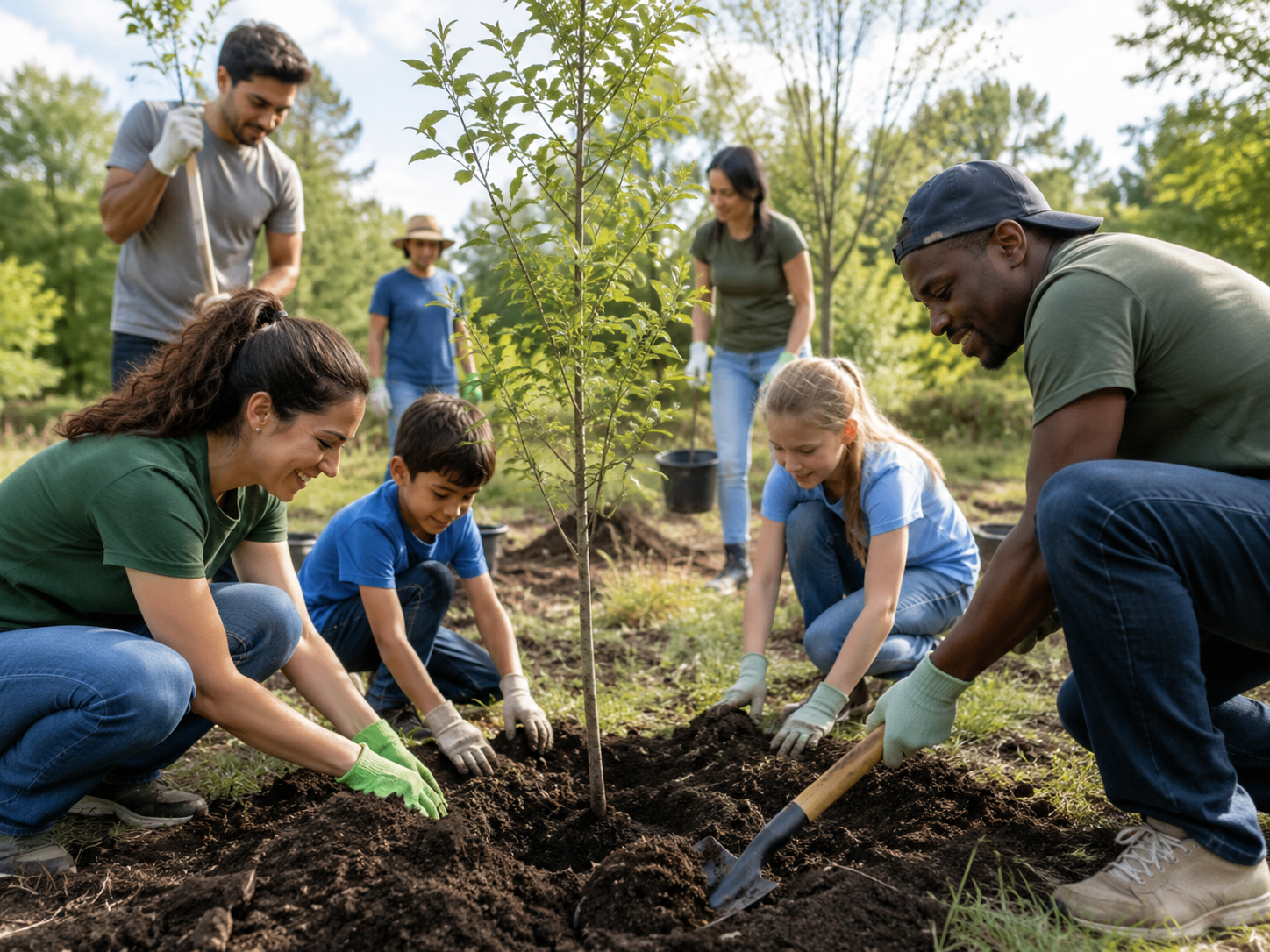
Beside him, his neighbour Aisha pushed a young oak sapling into the earth.
“You think it’ll survive?” she asked.
Malik looked around.
Concrete surrounded them in every direction. Trains thundered overhead. Towers climbed towards the clouds. Somewhere beyond the horizon, another ancient forest was probably falling.
He could not pretend everything was fine.
That was how they had reached this point in the first place.
But around him, hundreds of people were digging, planting, laughing and arguing over where the next vegetable beds should go.
Children chased one another between the trees.
Malik pressed his palm against the young oak.
“Give it a chance,” he said.
Years later, the tree would rise above the garden wall.
Its roots would push beneath pavements.
Its branches would reach towards apartment windows.
Birds would return.
And when Malik’s granddaughter asked why the enormous oak stood in the middle of a city built from concrete and steel, he would tell her the truth.
Once, the forests disappeared because people believed there would always be another one somewhere else.
Then the cities became jungles of their own.
Not jungles of trees, but of towers, traffic and millions of people trying to survive beside one another.
And somewhere along the way, they understood that saving the world did not begin with pretending nothing was wrong.
It began with refusing to let the last living things disappear.
Including themselves.